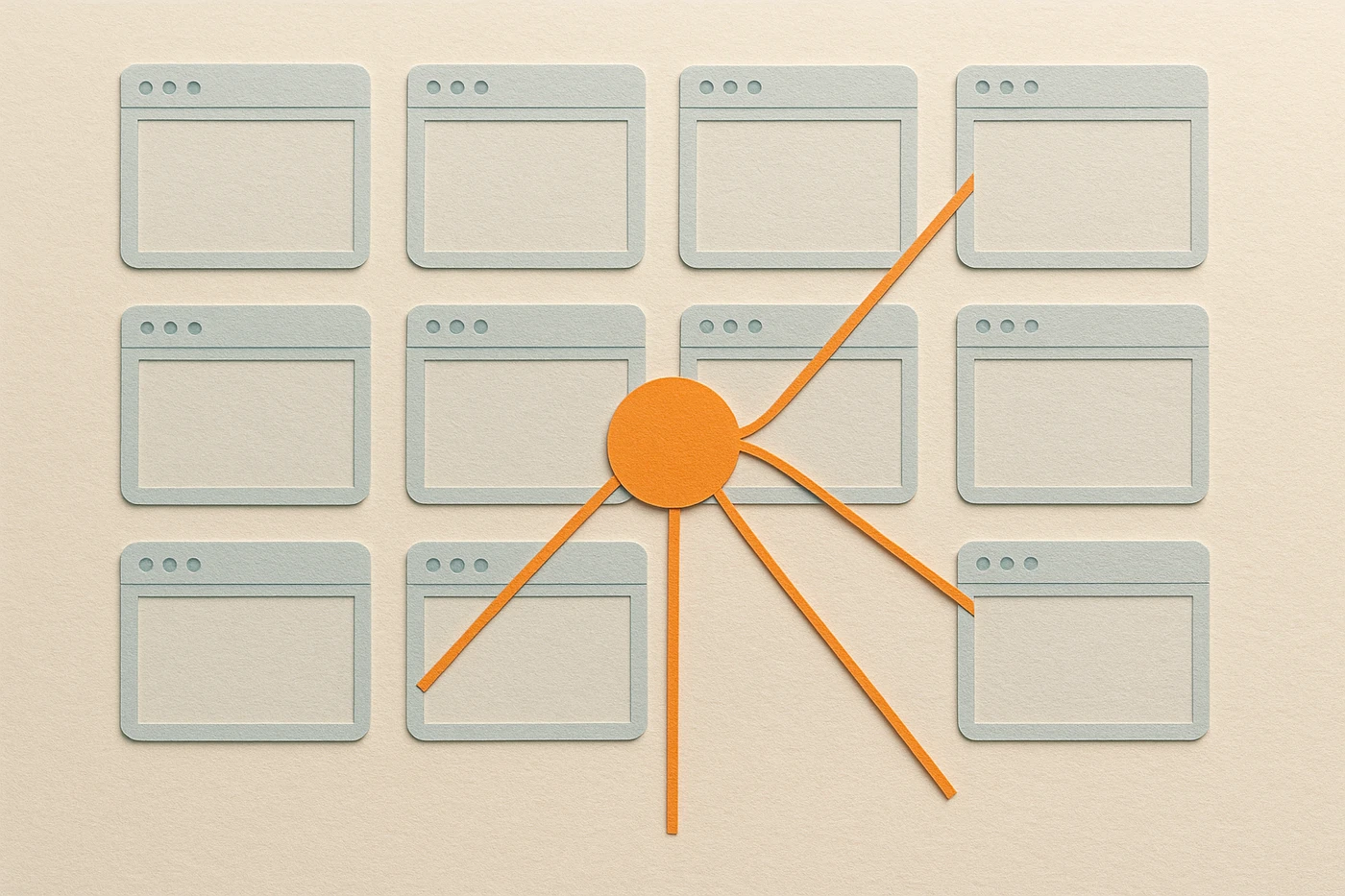
The future of web development isn't a new framework or faster build tool. It's a shift in who the browser serves: for two decades, we built pages for a person to read and click through. Now we're building for a client that acts on a person's behalf too, an AI agent that reads a page, fills a form, or pulls data across a dozen apps without seeing a single pixel. That shift changes four things at once: where data lives, who does the implementation, how the interface responds, and what the job protects. Local-first storage, agentic workflows, adaptive interfaces, and verification instead of just shipping, that's the whole list, and none of the four is a framework. As of September 2026, the frameworks keep shipping updates. The real change is underneath them.
What does the future of web development actually look like?
The future of web development looks less like a new stack and more like a new client: software that acts on a person's behalf instead of software a person browses. Four forces drive it: data moving local-first, implementation moving to agentic workflows, interfaces becoming adaptive, and verification replacing feature-shipping as the core skill.
I've been building for the web long enough to sit through a few of these "everything changes" cycles: jQuery to frameworks, server-rendered to single-page apps, mobile-first, JAMstack. Most of those were real shifts in how we built pages. This one is different, because the reader is changing, not just the tooling. That makes it a product question before it becomes an engineering one: when the thing consuming your software stops being a person, what you decide to build changes before how you build it does.
An AI agent doesn't scroll, hover, or notice a carefully art-directed hero image. It reads structure, calls APIs, and checks whether the result matches what it was asked for. Building for that audience, alongside the human one, is the actual future of web development, and it touches data, code, interface, and process all at once.
This site is a small proof of the direction I mean. thinkkeno.com runs on Eleventy, one inline stylesheet, no framework, and three network requests for the whole page. That's not a nostalgia project. It's the same argument in miniature: strip a page down to what actually does work, and you can see the work clearly enough to trust it, whether the reader is a person or a program.
What is local-first software, and why does it matter for what's next?
Local-first software keeps a person's data on their own device as the source of truth, syncing to a server instead of depending on one. It matters for the future of web development because an agent acting on someone's behalf needs data it can read and act on immediately, without waiting on a round trip to someone else's server.
The clearest articulation I've read of this idea comes from researchers at the software lab Ink & Switch, in a 2019 essay titled "Local-first software," arguing that people should own their data even when an app runs on cloud services. Their case was about ownership and resilience: your notes app shouldn't stop working because a server is down, and your files shouldn't disappear because a company shuts down.
For agentic workflows, local-first adds a second reason to care: speed and trust. An agent booking a flight or reconciling a spreadsheet on someone's behalf works faster and fails less when it's reading data that's already local and structured, instead of scraping a rendered page and hoping the layout didn't change. I've watched integrations break for exactly that reason: the data existed, but only as pixels, not as anything a program could reliably read.
This doesn't mean every app needs a local database and a sync engine by next quarter. It means the sites and tools worth building now treat data ownership and structured access as a feature, not an afterthought, because the audience that benefits from it, both human and agent, keeps growing.
How do agentic workflows change how web software actually gets built?
Agentic workflows move implementation from a person typing every line to an AI system running its own loop: read a task, write code, run it, check the result. For web development, that means the boundary between front end, API, and data layer has to be explicit enough for an agent to cross without a person filling gaps.
I wrote about this shift in more detail in Agentic Software Engineering: the job moves from writing code to specifying it precisely and verifying what comes back. Web development has its own version of that problem, and it's sharper than most, because a single app touches markup, styling, client state, server logic, and a database, each with its own conventions.
An agent that can competently edit a React component often stalls on the seam between that component and the API it calls, because the seam was never written down anywhere, just understood by whoever built it. The honest fix is the same one good engineering has always needed: name your contracts. Typed APIs, documented data shapes, and tests that check behavior instead of implementation details aren't new advice. They're what actually lets an agent work across the seams of a web app instead of getting stuck at them.
The practical shift for a web developer, in my experience, is spending more time on the shape of the system, what talks to what, and what each piece is allowed to assume, and less time hand-typing the parts an agent can now draft reliably.
What makes an interface adaptive instead of just responsive?
Responsive design adjusts layout to screen size; it's the same content rearranged for the device. Adaptive interfaces go further: they change what's shown, in what order, and through what modality, based on a person's context, history, or an AI system mediating the interaction, not just the screen width.
I laid out the pattern language for this in AI UX Patterns: previews, reversibility, provenance, escalation, and clear boundaries. An interface adapting to a model's uncertainty has to earn trust differently than one just adapting to a phone versus a desktop. A responsive grid never has to explain itself. An adaptive one, especially one shaped by AI, often does.
The practical version: a dashboard that reorders its own widgets based on what someone actually checks each morning is adaptive. A form that fills itself in from data an agent already has, then shows the person what it assumed and lets them correct it before submitting, is adaptive. Neither of those is solved by a media query.
The risk is real too. An interface that changes itself can also confuse the person using it, or bury a wrong assumption inside a confident-looking layout. The reversibility and provenance patterns I wrote about aren't decoration. They're what keeps an adaptive interface honest about what it changed and why.
Why does verification replace "shipping features" as the core skill?
When an agent can draft the code, the interface, and the data shape faster than a person can type them, the bottleneck moves to knowing whether the result is correct. Verification, tests that exercise real behavior, human review focused on decisions rather than syntax, and monitoring in production, becomes the skill that decides whether shipping fast is actually safe.
I spent years leading product and engineering through eight acquisitions inside a regulated clinical research organization, where nobody got to say "it works" without a real answer to "how do you know." That habit transfers directly here. The cost of writing code keeps dropping. The cost of being wrong about what the code does doesn't, and for a lot of web software, wrong means a broken checkout, a leaked field, or a form that silently drops data. How much verification to buy is a product call, not an engineering one. It is the same trade I ran on every roadmap in that job: what does it cost us to be wrong here, and is that cost worth the quarter it takes to be sure.
The teams I've seen handle this well treat verification as part of the build, not a gate bolted on at the end: contract tests between the front end and the API, monitoring that catches a regression in hours instead of a support ticket weeks later, and a habit of checking an agent's diff for what it changed that nobody asked for. That last one catches more real problems than people expect.
The honest answer is that this isn't a fun skill to sell. It doesn't demo well. But it's the one that decides whether the rest of what I'm describing here, agentic workflows, adaptive interfaces, local-first data, actually holds up in production instead of breaking the first time it meets a user nobody tested for.
What should a web developer actually learn right now?
Learn to write specifications precise enough for an agent to execute, to design data and API contracts a program can reason about, to build interfaces that stay honest while adapting, and to verify output you didn't personally type. The framework you reach for matters less than these four skills.
Here's the shift I'd actually point a web developer toward, the same way I compared assisted and agentic engineering in that earlier piece:
| Then | Now |
|---|---|
| Learn the framework of the year | Learn the contract between the pieces, so any framework can be swapped in |
| Ship a feature and move to the next ticket | Ship a feature and verify what an agent will do with it next |
| Design for a person's screen | Design for a person's screen and a program's read of the same page |
| Data lives on the server; the client asks for it | Data lives with the person; the server syncs it |
| Code review checks style and logic | Code review checks whether the right problem got solved |
None of this means frameworks stop mattering. I still reach for React when a project needs it and plain HTML with a templating engine when it doesn't, the same judgment call I was making back in the BEM-and-methodology arguments I was writing about in 2012. What's different is that the judgment call itself, not the framework, is the actual skill worth building. That's the part an agent still can't make for you.
For the teams I led, that judgment was the product work: deciding which of these four shifts a given product actually had to absorb this year, and which were someone else's problem for now. An agent can draft the code for all four. It cannot tell you which one your users will feel.