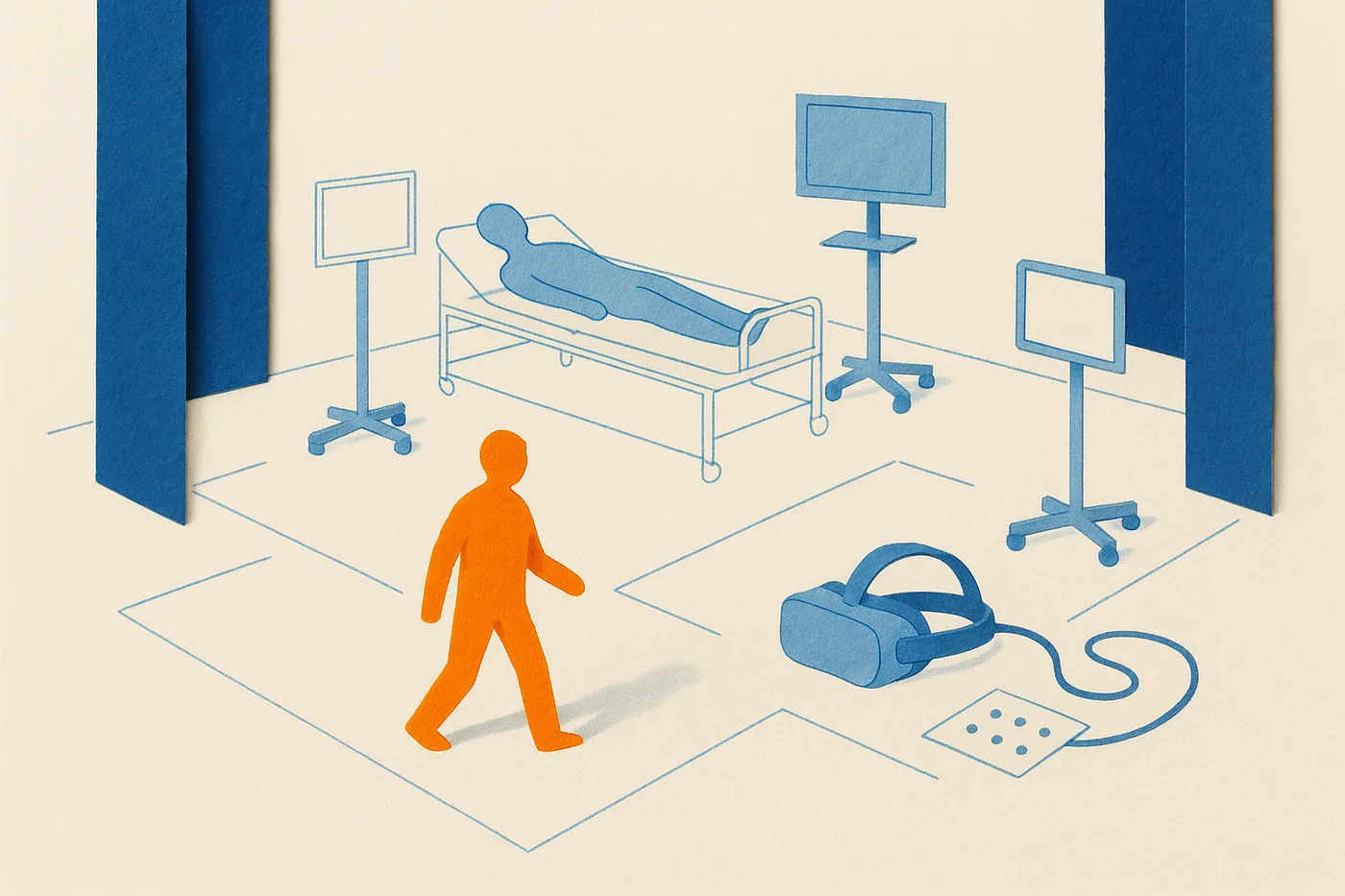
Healthcare simulation technology is the tools, mannequins, virtual patients, and VR scenarios that let clinicians rehearse high-stakes decisions before making them on a real patient, plus the feedback and facilitation that turn that rehearsal into real learning. As of August 2026, after spending most of my career building virtual patient simulations and immersive medical education products at WebMD, Medscape, and Shadow Health, I think the equipment gets too much of the attention and the system around it gets too little. The technology that matters isn't the headset or the mannequin. It's a four-part stack underneath: a realistic rehearsal scenario, structured feedback, skilled facilitation, and a change in the learner's confidence that outlasts the session. Skip any one layer, and the equipment is just an expensive prop.
What is healthcare simulation technology?
Healthcare simulation technology is the tools, mannequins, virtual patients, and VR scenarios that let clinicians rehearse high-stakes decisions before making them on a real patient, plus the feedback and facilitation that turn that rehearsal into real learning. The equipment is the delivery mechanism, not the product.
Here's what I keep coming back to: when people say "simulation technology," they usually mean the hardware. A high-fidelity mannequin that breathes and bleeds. A VR headset with a photorealistic patient room. A branching virtual-patient case with a hundred decision points.
I built products in that category for years. The hardware and content are real, and they matter. But none of it is the thing being purchased. What a hospital, a nursing school, or a medical education company is actually buying is a change in how a clinician behaves under pressure, later, when it counts. The mannequin is one way to deliver that. It's not the definition of it.
That distinction sounds academic until you watch two programs with the same budget produce different results, because one spent it on fidelity and the other spent it on the system around the fidelity.
What are the four layers of the simulation stack?
Rehearsal, feedback, facilitation, and confidence. Rehearsal lets the learner practice the decision, feedback tells them what their choice did, facilitation makes sure the lesson survives past the room, and confidence is the measurable change that outlasts the session. Skip a layer and the equipment is an expensive prop.
I think of it as a stack because each layer depends on the one below it actually working. Here's the map I use when I'm evaluating or building a simulation product:
| Layer | What it does | What breaks without it | Example modality |
|---|---|---|---|
| Rehearsal | Lets the learner practice making the decision, not just watch someone else make it | The learner arrives at the real event never having made the call before | High-fidelity mannequin, VR clinical scenario, branching virtual-patient case |
| Feedback | Shows the learner what their choice actually did, during the scenario or right after | The learner repeats the same mistake because nothing ever corrected it | A mannequin's physiological response, a virtual patient's changing vitals or outcome |
| Facilitation | A trained person frames the debrief so the lesson generalizes past this one scenario | Learners leave defensive or numb instead of changed | A structured, trained-facilitator debrief, not a checklist read aloud |
| Confidence | The measurable shift in how ready the learner feels, and performs, on the next real case | The program looks busy on a dashboard but nothing changes at the bedside | Pre/post confidence and competency assessment |
The rows that get funded first are almost always rehearsal and, sometimes, feedback. They're the visible, purchasable parts. Facilitation is a training and staffing problem, not a line item on a hardware quote, so it's the layer most likely to get squeezed when budgets tighten. That's an observation from building and buying in this space for over a decade, not a universal law. I've also seen well-resourced programs get it right.
How does simulation build clinical confidence, not just skill?
Skill is being able to perform the task correctly. Confidence is trusting yourself to perform it under pressure, which only comes from rehearsing the decision enough times that it stops feeling foreign. A well-run debrief is what converts one rehearsal into confidence instead of just a memory.
This distinction shows up constantly in nursing and clinical education research under the name debriefing, and it's the part of the stack I'd defend most if a budget forced a choice. The educator and researcher Pamela Jeffries built much of the modern academic framework around exactly this idea, that the structured reflection after a scenario is where the actual learning transfer happens, not the scenario itself.
I saw the same pattern building virtual patient products: a learner could get every decision "right" in a scenario and still walk away without more confidence, because nobody helped them connect the choice to the reasoning behind it. The scenario taught an answer. The debrief is what teaches judgment.
Where do simulation programs actually fail?
Most failures I've seen weren't the technology. They were budget going to fidelity, better mannequins, sharper graphics, while facilitator training and debrief time got cut. A photorealistic scenario with a rushed, unskilled debrief teaches less than a simple scenario with a great one.
That's my honest read after years on the product and platform side of this industry, and it's an inference from a lot of specific programs, not a claim I can attach a single statistic to. The pattern is consistent enough that I trust it: fidelity is the easiest thing to demo to a stakeholder, and the easiest thing to point to when justifying a budget renewal. A great debrief doesn't photograph well in a sales deck.
The other common failure is treating simulation as a one-time event instead of a rehearsal cadence. One scenario, run once a year, builds almost nothing durable. The confidence layer is a curve, not a checkbox, and it needs enough repetitions to actually move.
What should product teams test first before scaling a simulation program?
Test whether a single scenario changes a learner's stated confidence and decision-making on a follow-up case, before you invest in more hardware or more content. If the smallest version of the loop, rehearsal, feedback, facilitation, doesn't move that number, more fidelity won't fix it.
This is the same instinct I wrote about in what an MVP actually tests: find the cheapest version of the loop that can prove or disprove the hypothesis, before you spend real budget scaling the wrong thing. In simulation, the hypothesis is "this rehearsal, done this way, changes behavior." Test that with the smallest scenario you can build, a real debrief, and a before-and-after confidence check. Everything after that, more fidelity, more content, more seats, is scaling something you've already proven works.
It's worth asking the same question I keep asking about AI adoption in will AI replace software engineers: the tools in this space keep getting more capable, VR headsets cheaper, virtual patients more responsive, and none of that changes what the stack is for. Better rehearsal tools still need feedback, facilitation, and a way to prove the confidence actually moved.
I'm not writing this as clinical advice, and none of it is. It's a product and learning-design view from someone who spent most of his career shipping this category. Where the technical or research claims get more specific than my own build history, I've linked the source or kept the claim deliberately qualitative.
The equipment is the part anyone can buy. The stack is the part that has to be built.
I write more about how I make these calls, and the fifteen years of specific programs behind them, on the About page.